
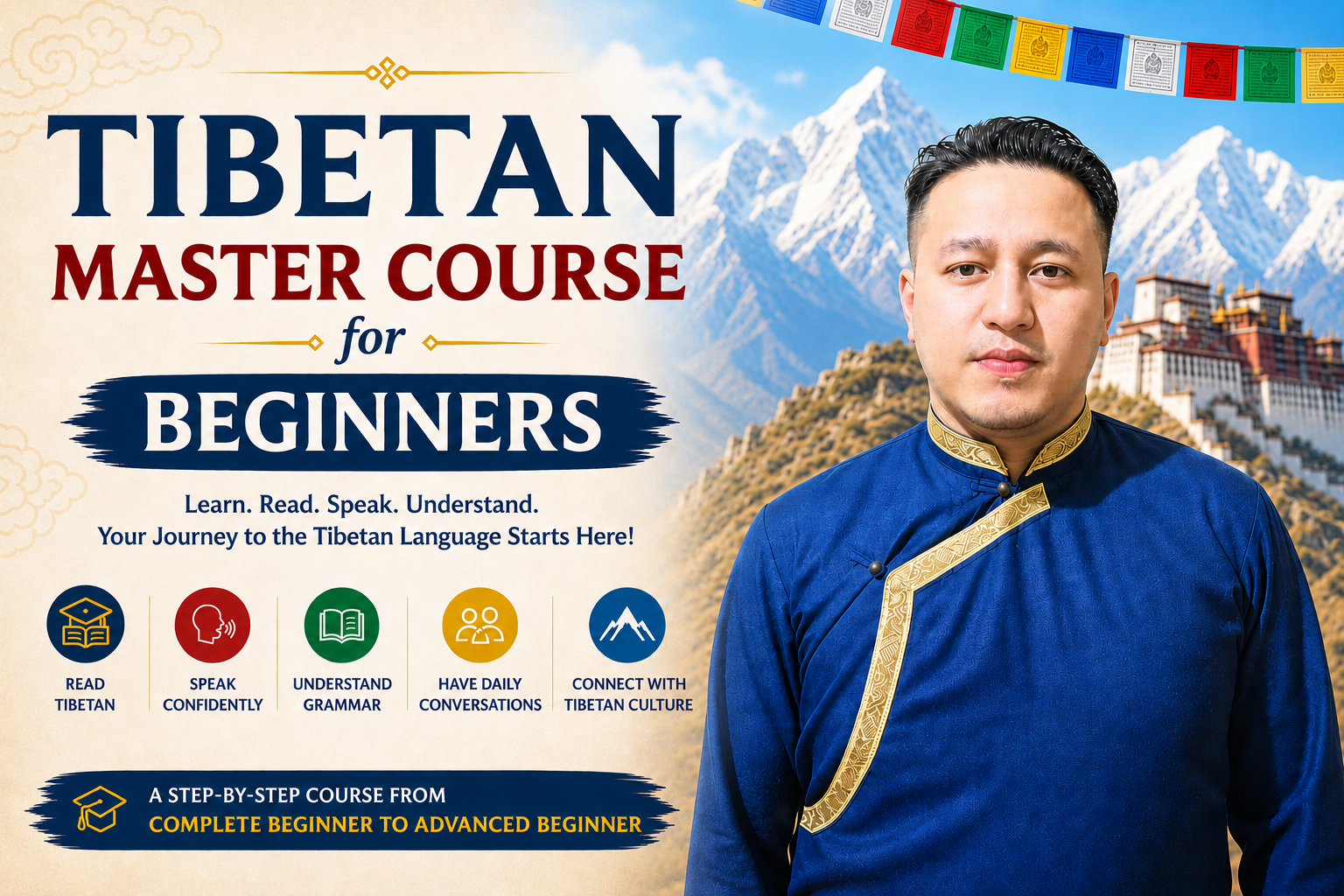
Tibetan Master Course for Beginners

Wishlist Share

About Course

Tibetan Master Course for Beginners

Begin your journey into the Tibetan language with a complete step-by-step course designed especially for beginners.

This course starts entirely from scratch and gradually guides students up to the A1 level, making Tibetan learning simple, structured, and accessible for everyone. Whether you are interested in Tibetan culture, Buddhism, travel, or personal growth, this program provides a strong and practical foundation in the language.

Inside this course, you will learn:

  • Basic Tibetan consonants and pronunciation

  • How to read and form Tibetan words and sentences

  • Essential grammar foundations

  • Sentence construction and everyday expressions

  • Verb conjugations for first, second, and third person

  • Practical vocabulary and conversational Tibetan

  • Basic communication skills for real-life situations

By the end of the course, students will be able to read any Tibetan text, understand foundational auxiliary verb rules, and confidently hold simple conversations in Tibetan up to A1 level.

This master class is designed with clarity, patience, and progressive learning methods so that even complete beginners can develop confidence and fluency step by step.

Start your Tibetan learning journey today and build a meaningful connection with the Tibetan language, culture, and tradition.

Show More

What Will You Learn?

  • Learn the complete foundation of the Tibetan language from scratch to beginner conversational level.
  • Read and recognize all 30 Tibetan consonants with proper pronunciation techniques with the help of the three root tones.
  • Master the four Tibetan vowels and learn how to combine them with consonants accurately.
  • Understand Tibetan stacked letters, including superscript and subscript letter formations.
  • Learn prefixes, suffixes, and post-suffixes to improve reading and word construction skills.
  • Develop Tibetan spelling (Jorlok) and reading abilities through practical vocabulary such as days, colors, numbers, months, and seasons.
  • Build essential grammar skills, including pronouns, auxiliary verbs, possessive forms, and WH-questions.
  • Form basic Tibetan sentences confidently using verb conjugation across first, second, and third person forms in present, past, and future tenses.
  • Gain the ability to read, pronounce, understand, and engage in simple everyday conversations in Tibetan with confidence.

Course Content

Mastering the 30 Tibetan Consonants
* Identifying the 3 Root Tones and 30 consonants in Tibetan. * How to read the 30 Tibetan consonants, one by one, with helpful illustrations. * A collection of monosyllabic word examples derived from the 30 Tibetan consonants. * Identifying the two most important Punctuation Symbols in Tibetan.

  • Module 01 – Introduction
  • Mastering the 30 Tibetan Consonants
    22:58

Mastering the Four Tibetan Vowels
* Identifying the 4 vowels and their sounds in Tibetan. * How to combine each of the 4 vowels with every consonant and read them correctly. * Examples with the pictures.

The Three Superscript Letters & The Four Subscript Letters
* The Three Superscript (surmounted) Letters in Tibetan: (ར་ RaGo, ལ་ LaGo, ས་ SaGo) with examples. * The Four Subscript (subjoined) Letters in Tibetan: (ཡ་ YaTak, ར་ RaTak, ལ་ LaTak, ཝ་ WaSur) with examples. * The Seventeen Stacked Letters. * The Seventeen Stacked Letters with vowels.

Prefixes / Suffixes / Post-Suffixes
* The 5 Prefixes with examples. * The 10 Suffixes with examples. * The 2 Post-Suffixes with examples.

Spelling & Reading Practice: Days, Colors, Numbers, Months & Seasons
How to Spell (Jorlok) and Read in Tibetan with the Following Topics: * Days of the Week in Tibetan. * Colors in Tibetan. * Cardinal Numbers & Ordinal Numbers. * The 12 Months in Tibetan. * The Four Seasons in Tibetan.

Pronouns and Auxiliary Verbs
Three Persons in Tibetan. * “To Be / To Not Be” — First & Third Person (with examples) * “To Have / To Not Have” — First & Third Person (with examples) * “Yes” and “No” Questions with First & Third Person

WH-questions
* Possessive Adjectives / Possessive Pronouns. * A clear and detailed explanation of all WH-questions (what, where, why, how, how many), with practical examples.

Verb Conjugation
Classification of Verbs in Tibetan * Volitional and Non-Volitional Verbs * Transitive and Intransitive Verbs Verb Conjugation According to Grammatical Person * First, Second, and Third Person Forms * Tense and Aspect: Present, Past, and Future

Student Ratings & Reviews

No Review Yet
No Review Yet